Saturday, March 12, 2022

1966 Baltimore Orioles

So I've started doing teams of yesteryear, and I think they'll offer interesting options for team-building, and show us how teams were built differently at times.

I'm starting with the 1966 Baltimore Orioles, who shocked the major leagues by sweeping the Los Angeles Dodgers out of the World Series.

Lineup: I won't lie, I'm beginning to understand why they lowered the mound in time for the 1969 season. The champs have exactly ONE hitter with an on-base above 8. There is some decent pop, but you're hoping you can scrape a few runs out.

Note: The Brooks Robinson picture was auto-generated in the Showdown bot, and the Frank Robinson card is from the Greatest MLB Showdown Project, here: https://greatestmlbshowdown.blogspot.com/2019/02/in-memory-of-frank-robinson.html

I'll be honest, this Triple Crown from Frank "I am become Death, Destroyer of Baseballs" Robinson is one of the funniest stories in MLB history. The Reds traded Robinson because he was about to turn 30, and they didn't want a player on the wrong side of 30. This angered Frank, who punished baseballs severely the whole season, capping with the WS MVP with 4 hits in the series, including a triple and two of the five homeruns hit between BOTH teams.

And he was a starter-level player through his age-38 season. Oops!

Total Points: 1,910
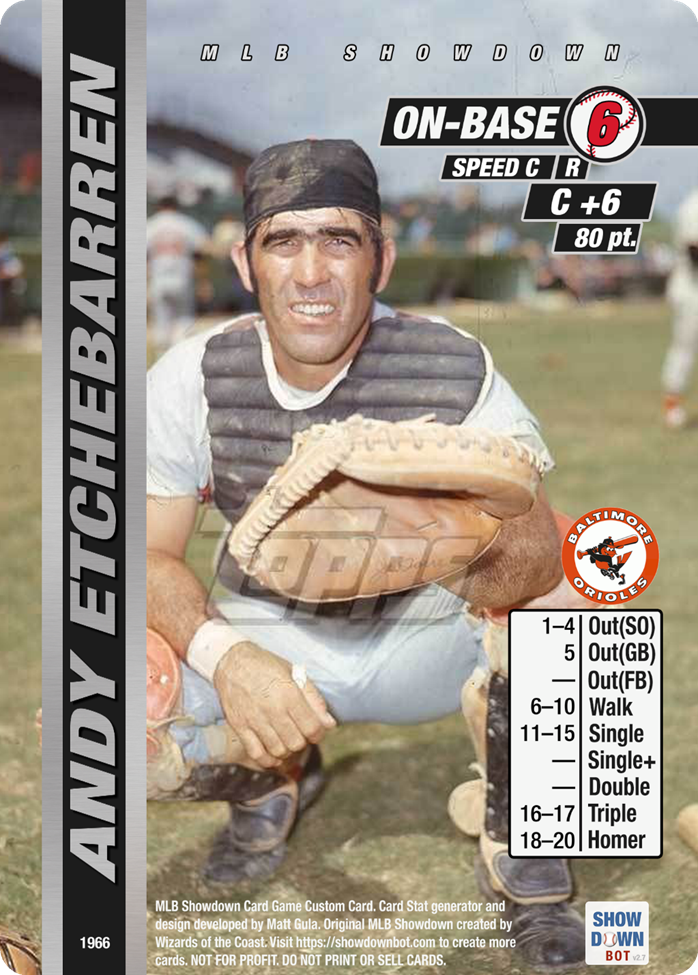


Bench: ...only Snyder is draftable, in my opinion.

Total Points: 410


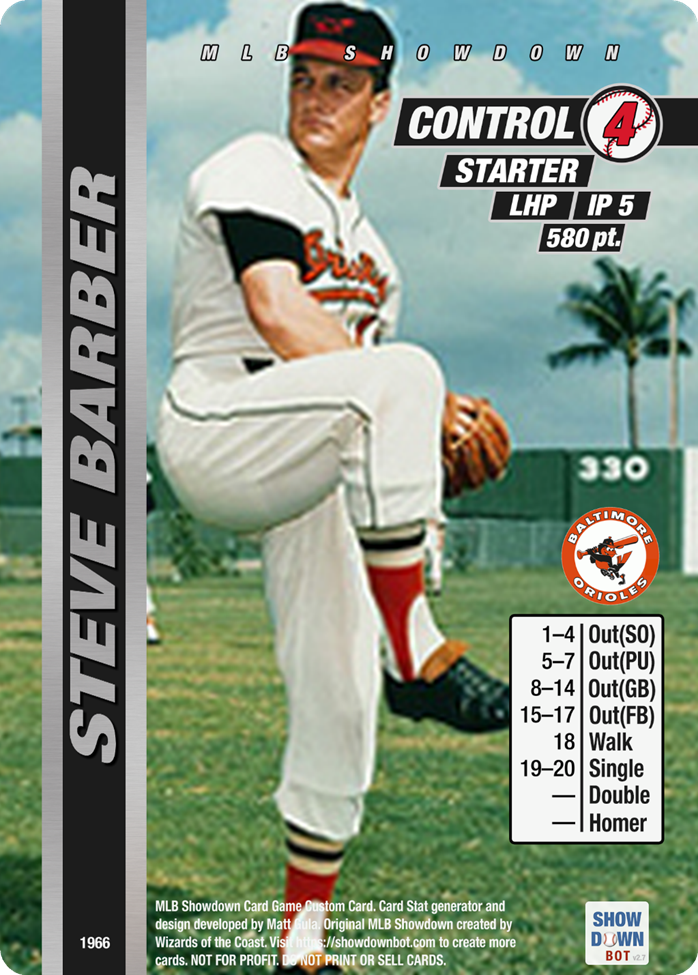
Rotation: They are ordered by IP, not by point value. All four are draftable, though it will depend on how you intend to build your bullpen. 3 of the four was under 24 at the time; Barber is the 'old man' of the group and the only one that was an All-Star that year. It was his last good season; tendinitis in his elbow made him miss time, including the WS. He may be best remembered for being in  "Ball Four" than being on this team.

Total Points: 1,970


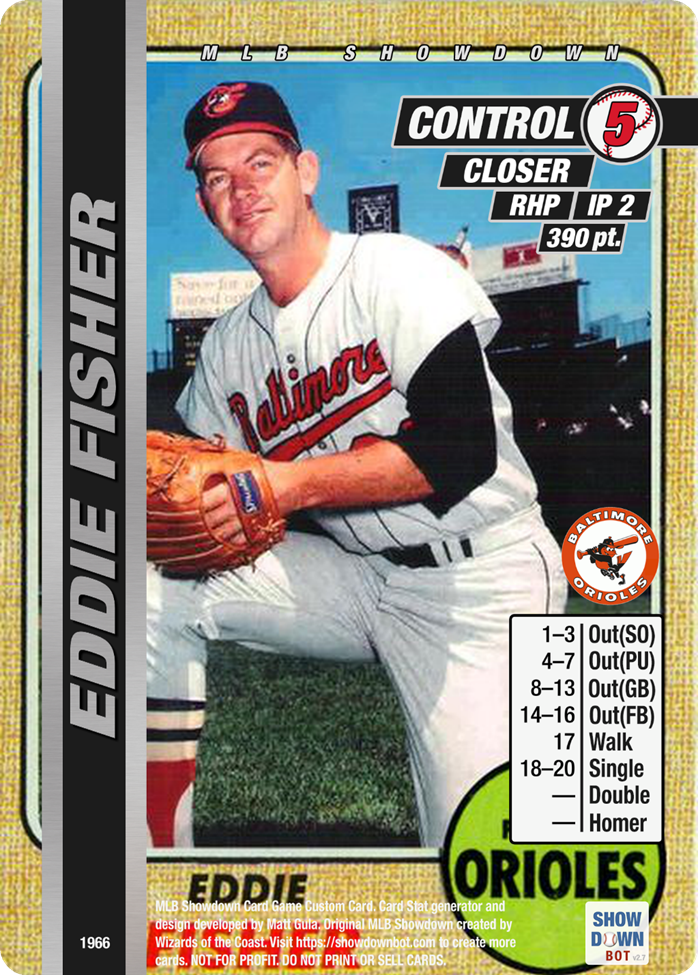
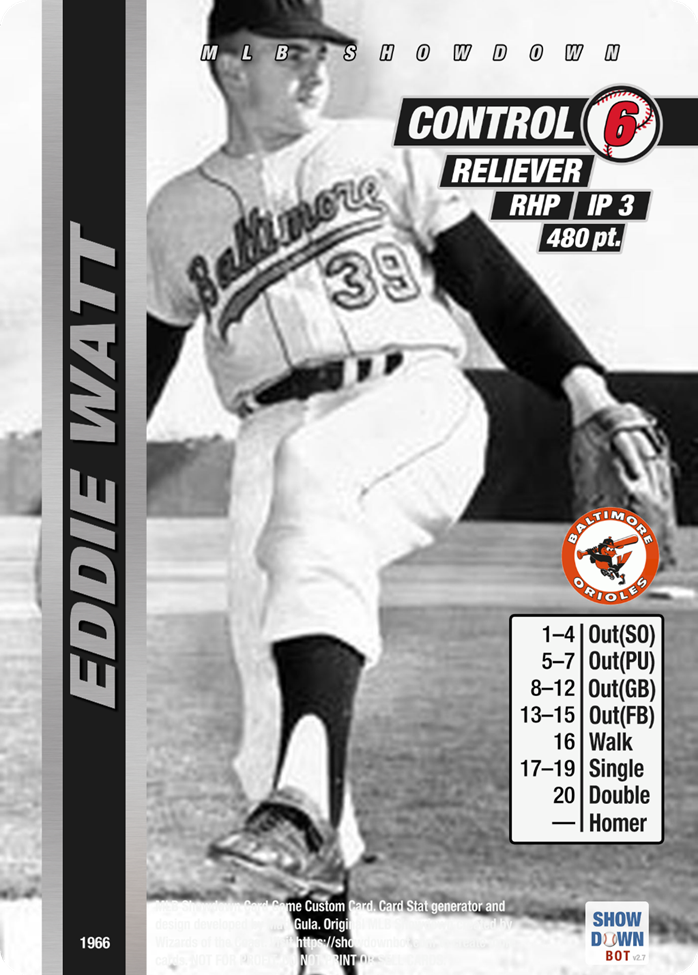
Bullpen: Wow, these are some pricey relievers! All pitch at least two innings, could be VERY valuable depending on how your league handles reliever appearances/innings.

Total Points: 1,620


Total Points Hitting is 2,320
Total Points Pitching is 3,590!!

Total of 5,910

Thank you for looking!

Friday, March 4, 2022

I'm back!

 Thanks to the Showdownbot I can now make cards that look someway presentable, so stay tuned for more MLB Showdown cards!

Wednesday, July 30, 2014

A look at two 'risky' Orioles relievers

I'm an Orioles fan. I'm a fan of pitchers who have odd charts. And when I have both...

*note: stats are SO/PU/GB/FB/BB/1B/2B/HR

Koji Uehara '11/Control 4/IP 1/cost-190
1-9/--/10-12/13-19/--/--/--/20

I kinda like pitchers who have a natural 20 HR on their chart. Not all the time, but when they can mitigate the runs they give up (like Arthur Rhodes 00 walking on 17-19 and then giving up the 20 HR) it's bearable (compared with, say, Brett Tomko who goes 16 BB, 17 1B, 18-19 2B(!) and then the 20 HR). They also tend to be cheaper than comparable players, which can be helpful in team building.

Koji here has decent control with his +4, but more importantly only has a single non-out result. True, it's a home run, but if he gets the pitch, batters swing an out 95% of the time on his chart.

Hoyt Wilhelm/Control +2/IP 2/Cost 340
1-5/6-9/10-17/18-20/--/--/--/--

Yes, I was a big fan of that JC Romero card where he had no hit results. I believe it also fits the knuckle-balling Wilhelm pretty well; if his knuckler is floating around the strike zone, it's impossible to hit. If his knuckler is flat though... prepare for some pain. His low control is the risk here, but having an all-out chart I think makes up for it.


I'll be posting pictures later.

edit:


Tuesday, May 21, 2013

New York State of Mind: Darryl Strawberry and Gary Carter

Let's head across town to see what going on in Flushing.

Darryl Strawberry. He was the first case where I looked at the stats and said "Wow, it's a shame what he did with his career. What might have been..."

His OB 9 and six extra-base results usually put him in the 3-4-5 slot on a team. I like that his defense is average, and the speed will surprise some people. Overall, a nice little slugger for 450 points, which can allow for nice back-up.

From the 2011 Topps set.

Gary Carter is a Met and not an Expo because I just liked this one picture best.

He's on the border with OB 7/8, which explains the five outs he has on his card. No real weaknesses, just a catcher with excellent defense who does okay with only four extra-base results (two of which are homers), and a whole lot of singles. I would park him maybe in the #2 slot (though his speed is a potential problem) or lower in the order (5-6-7) because he can still drive in runners with all those singles.

Card made from a Google image. Not hard to find.

New York State of Mind: Phil Rizzuto


So, having discussed how I did the "Legends", let's start in the Big Apple!

Phil Rizzuto represents the traditional MLB shortshop: good defense, low power. Unlike a true good-field/no-hit shortshop though, he could actually get hits (mainly singles, but whatever).

Clocking in at an OB 8, Rizzuto is a good candidate to lead off in a line-up, especially coupled with his Speed A. SS+5 is always a nice thing to have, and his low cost (240 points) allows you to take a chance of hitters with questionable fielding but better bats around the infield.

Now, there isn't a lot of power. Only three extra-base results, none being homers, will limit some stats (like RBI). But, all around not a bad little piece.

A brief review of my "Legends" series of MLB Showdown cards

When I make my "Legends" series of MLB Showdown customs*, I have to be careful how to scrutinize the data.

1) Dead-ball era and 1960s era hitters are a pain to try and do. Just do the best you can, and I usually up the offense a little bit, imagining if they played in today's era.

2) Peaks matter. I usually take a stretch of time when the player was at the top of their game (as judged by OPS+ or ERA+ as a quick reference), not taking into account decline because frankly you remember those players at their best, don't you?

3) Take the down with the bad, don't cherry-pick. This isn't usually a problem, but players like Roy Campanella were up and down. Just smooth out the data.

4) Make an average of the peak (min. 5 seasons I prefer) and extrapolate from there.

*It's got Hall of Famers and non-Hall of Famers, so the blanket term for cards for retired players is "Legends".

Friday, May 17, 2013

Returning

My oh my, life has gotten in the way for far too long. I'm planning a wedding for this summer, so forgive me for the long absence.

Some of you may have noticed that the costs for some of the MLB Showdown pitchers differ a bit (usually costing more) from their counterparts that were actually printed. The reason being simple... the costs were originally undercosted.

Say you have a 19 pitcher (16 outs +3 Control) and a 20 pitcher (16 outs +4 Control). Assuming IP 6, the first will cost about 330 points, the second about 450 points. One step up to a 21 pitcher, and we have 550 points.

Now, a +5 control pitcher (15 outs) and a +4 control pitcher (16 outs) are functionally the same. Both are 20 pitchers.

Why is it that these 20 pitchers, with 6 IP, when stacked with other 20 pitchers with 7 IP only see a 30 point increase?

As such, a 20 pitcher with IP 7 has been bumped up a smidge to about 510 to 530 points to bring costs in line.

Also, the 2001 cards were undercosted as a whole as well. Power creep is best done when not blatant...

Sunday, January 20, 2013

Toronto Blue Jays: 2011 edition

Ricky Romero: Starter, Control +4, IP 7, 580 points
1-5 SO, 6-8 PU, 9-14 GB, 15-17 FB, 18 BB, 19 1B, 20 2B, -- HR

Brandon Morrow: Starter, Control +3, IP 6, 430 points
1-9 SO, -- PU, 10-12 GB, 13-17 FB, 18-19 BB, -- 1B, 20 2B, -- HR

Brett Cecil: Starter, Control +4, IP 6, 230 points
1-4 SO, 5-6 PU, 7-10 GB, 11-16 FB, 17 BB, 18 1B, 19 2B, 20 HR

Kyle Drabek: Starter, Control +0, IP 6, 40 points
1-4 SO, 5-8 PU, 9-12 GB, 13-16 FB, 17-20 BB, -- 1B, -- 2B, -- HR

Octavio Dotel: Reliever, Control +5 , IP 1, 230 points
1-7 SO, 8-9 PU, 10-11 GB, 12-17 FB, 18 BB, 19 1B, 20 2B, -- HR

Frank Francisco: Reliever, Control +5, IP 1, 140 points
1-7 SO, 8 PU, 9-12 GB, 13-15 FB, 16-17 BB, 18-19 1B, 20 2B, -- HR

Marc Rzepczynski: Reliver, Control +2, IP 1, 140 points
1-6 SO, 7-8 PU, 9-16 GB, 17-18 FB, 19-20 BB, -- 1B, -- 2B, -- HR

JP Arencibia: C+5, Onbase 5, speed C, 210 points
1-5 SO, -- GB, -- FB, 6-8 BB, 9-11 1B, -- 1B+, 12-14 2B, 15 3B, 16-20 HR

Aaron Hill: 2B+3, Onbase 6, speed A, 170 points
1 SO, 2-4 GB, 5 FB, 6-8 BB, 9-12 1B, 13 1B+, 14-17 2B, 18 3B, 19-20 HR

Yunel Escobar: SS+3, Onbase 9, speed B, 360 points
1 SO, 2-3 GB, 4 FB, 5-8 BB, 9-16 1B, -- 1B+, 17-19 2B, -- 3B, 20 HR

Edwin Encarnacion: 3B+0, Onbase 7, speed C, 170 points
1-2 SO, 3 GB, 4 FB, 5-7 BB, 8-13 1B, -- 1B+, 14-17 2B, -- 3B, 18-20 HR

Jose Batista: LR/RF+1, 3B+2, Onbase 10, speed B, 700 points
1-2 SO, -- GB, -- FB, 3-9 BB, 10-14 1B, -- 1B+, 15 2B, -- 3B, 16-20 HR

Saturday, January 19, 2013

Tampa Bay Rays: 2011 edition

James Shields: Starter, Control +5, IP 8, 650 points
1-6 SO, 7-9 PU, 10-14 GB, 15-16 FB, 17 BB, 18-19 1B, 20 2B, -- HR

David Price: Starter, Control +4, IP 7, 580 points
1-6 SO, 7-8 PU, 9-14 GB, 15-17 FB, 18 BB, 19 1B, 20 2B, -- HR

Jeff Niemann: Starter, Control +5, IP 6, 460 points
1-5 SO, 6 PU, 7-11 GB, 12-15 FB, 16 BB, 17-19 1B, 20 2B, -- HR

Jeremy Hellickson: Starter, Control +4, IP 6, 450 points
1-4 SO, 5-6 PU, 7-10 GB, 11-16 FB, 17-18 BB, 19 1B, 20 2B, -- HR

Wade Davis: Starter, Control +3, IP 6, 340 points
1-4 SO, 5 PU, 6-10 GB, 11-16 FB, 17-18 BB, 19 1B, 20 2B, -- HR

Kyle Farnsworth: Reliever, Control +3, IP 1, 220 points
1-6 SO, 7-9 PU, 10-17 GB, 18-19 FB, -- BB, 20 1B, -- 2B, -- HR

Joel Peralta: Reliever, Control +5, IP 1, 200 points
1-6 SO, 7 PU, 8-9 GB, 10-17 FB, 18 BB, 19 1B, 20 2B, -- HR

Juan Cruz: Reliever, Control +4, IP 1, 170 points
1-6 SO, 7-8 PU, 9-10 GB, 11-16 FB, 17-19 BB, -- 1B, 20 2B, -- HR

Johnny Damon: DH, Onbase 7, speed A, 210 points
1-2 SO, 3 GB, 4 FB, 5-7 BB, 8-13 1B, 14 1B+, 15-17 2B, 18 3B, 19-20 HR

Kelly Shoppach: C+8, Onbase 5, speed C, 210 points
1-4 SO, 5 GB, -- FB, 6-10 BB, 11-14 1B, -- 1B+, 15 2B, -- 3B, 16-20 HR

Carlos Pena: 1B+0, Onbase 8, speed C, 280 points
1-3 SO, -- GB, -- FB, 4-10 BB, 11-14 1B, -- 1B+, 15-17 2B, -- 3B, 18-20 HR

Casey Kotchman: 1B+0, Onbase9, speed C, 270 points
1 SO, 2-3 GB 4 FB, 5-8 BB, 9-16 1B, -- 1B+, 17-19 2B, -- 20 HR

Ben Zobrist: 2B+3, LF/RF+1, Onbase 8, speed A, 320 points
1-3 SO, -- GB, 4-5 FB, 6-9 BB, 10-12 1B, 13 1B+, 14-17 2B, 18 3B, 19-20 HR

Reid Brignac: SS+3, Onbase 3, speed B, 30 points
1-4 SO, 5 GB, -- FB, 6-7 BB, 8-15 1B, -- 1B+, 16-18 2B, -- 3B, 19-20 HR

Evan Longoria: 3B+3, Onbase 8, speed B, 300 points
1 SO, 2 GB, 3-4 FB, 5-10 BB, 11-14 1B, -- 1B+, 15-17 2B, -- 3B, 18-20 HR

Desmond Jennings: LF/RF+2, Onbase 8, speed A, 270 points
1-2 SO, -- GB, 3-4 FB, 5-9 BB, 10-14 1B, 15 1B+, 16-17 2B, 18 3B, 19-20 HR

Matt Joyce: LF/RF+1, Onbase 8, speed A, 270 points
1-4 SO, -- GB, -- FB, 5-7 BB, 8-13 1B, 14 1B+, 15-18 2B, -- 3B, 19-20 HR

BJ Upton: CF+2, LF/RF+1, Onbase 7, speed A, 300 points
1-5 SO, -- GB, -- FB, 6-10 BB, 11 1B, 12-13 1B+, 14-16 2B, 17 3B, 18-20 HR

New York Yankees: 2011 edition

CC Sabathia: Starter, Control +5, IP 7, 520 points
1-6 SO, 7 PU, 8-12 GB, 13-15 FB, 16 BB, 17-19 1B, 20 2B, -- HR

Ivan Nova: Starter, Control +4, IP 6, 460 points
1-4 SO, 5 PU, 6-13 GB, 14-16 FB, 17-18 BB, 19 1B, 20 2B, -- HR

Bartolo Colon: Starter, Control +3, IP 6, 430 points
1-5 SO, 6-7 PU, 8-13 GB, 14-17 FB, 18 BB, 19 1B, 20 2B, -- HR

AJ Burnett: Starter, Control +3, IP 6, 200 points
1-6 SO, 7 PU, 8-13 GB, 14-16 FB, 17-18 BB, -- 1B, 19 2B, 20 HR

Mariano Rivera: Reliever, Control +4, IP 1, 220 points
1-6 SO, 7-8 PU, 9-14 GB, 15-18 FB, 19 BB, 20 1B, -- 2B, -- HR

David Robertson: Reliever, Control +6, IP 1, 160 points
1-10 SO, -- PU, 11-15 GB, -- FB, 16-18 BB, 19 1B, 20 2B, -- HR

Luis Ayala: Reliever, Control +4, IP 1, 140 points
1-5 SO, 6 PU, 7-14 GB, 15-16 FB, 17-18 BB, 19 1B, 20 2B, -- HR

Jorge Posada: DH/1B+0, Onbase 7, Speed C, 210 points
1-2 SO, 3-4 GB, 5-6 FB, 7-10 BB, 11-14 1B, -- 1B+, 15-17 2B, -- 3B, 18-20 HR

Russell Martin: C+6, Onbase 7, speed B, 220 points
1-2 SO, -- GB, 3-4 FB, 5-8 BB, 9-14 1B, -- 1B+, 15-17 2B, -- 3B, 18-20 HR

Mark Teixeira: 1B+0, Onbase 7, speed C, 300 points
1-2 SO, -- GB, 3 FB, 4-8 BB, 9-12 1B, -- 1B+, 13-15 2B, -- 3B, 16-20 HR

Robinson Cano: 2B+3, Onabse 8, speed B, 310 points
1-3 SO, -- GB, 4 FB, 5-6 BB, 7-14 1B, -- 1B+, 15-18 2B, -- 3B, 19-20 HR

Derek Jeter: SS+1, Onabse 8, speed B, 200 points
1-2 SO, 3-4 GB, -- FB, 5-7 BB, 8-16 1B, 17 1B+, 18-19 2B, -- 3B, 20 HR

Alex Rodriguez: 3B+3, Onbase 9, speed C, 370 points
1-2 SO, -- GB, 3-5 FB, 6-9 BB, 10-14 1B, -- 1B+, 15-17 2B, -- 3B, 18-20 HR

Nick Swisher: LF/RF+2, Onbase 9, speed C, 340 points
1-3 SO, -- GB, 4 FB, 5-10 BB, 11-15 1B, -- 1B+, 16-18 2B, -- 3B, 19-20 HR

Andruw Jones: LF/RF+1, Onbase 8, speed C, 330 points
1-4 SO, -- GB, -- FB, 5-9 BB, 10-14 1B, -- 1B+, 15-16 2B, -- 3B, 17-20 HR

Brett Gardner: LF/RF+2, Onbase 8, speed A, 260 points
1-2 SO, 3-5 GB, -- FB, 6-9 BB, 10-14 1B, 15-16 1B+. 17-18 2B, 19 3B, 20 HR

Curtis Granderson: OF+2, Onbase 9, speed A, 600 points
1-3 SO, -- GB, 4 FB, 5-9 BB, 10-12 1B, 13 1B+, 14-15 2B, 16 3B, 17-20 HR

Thursday, January 17, 2013

Boston Red Sox: 2011 edition

In case people are curious about the players I chose, almost all had a card in the 2011 Topps baseball card set, which I put the stats onto. This is why some teams like the BoSox have more members than the teams I like; it's just easier to roll with what you have.

Josh Beckett: Starter, Control +5, IP 6, 510 points
1-6 SO, 7-8 PU, 9-12 GB, 13-16 FB, 17 BB, 18-19 1B, 20 2B, -- HR

Jon Lester: Starter, Control +5, IP 6, 460 points
1-6 SO, -- PU, 7-13 GB, 14-15 FB, 16-17 BB, 18-19 1B, 20 2B, -- HR

Clay Buchholz: starter, Control +4, IP 6, 450 points
1-5 SO, 6-7 PU, 8-12 GB, 13-16 FB, 17-18 BB, 19 1B, 20 2B, -- HR

Tim Wakefield: Starter, Control +3, IP 5, 260 points
1-4 SO, 5-6 PU, 7-10 GB, 11-16 FB, 17 BB, 18-19 1B, 20 2B, -- HR

John Lackey: starter, Control +0, IP 6, 160 points
1-4 SO, 5-7 PU, 8-13 GB, 14-18 FB, 19 BB, 20 1B, -- 2B, -- HR

Alfredo Aceves: Reliever, Control +5, IP 1, 180 points
1-4 SO, 5-6 PU, 7-10 GB, 11-16 FB, 17-18 BB, 19 1B, 20 2B, -- HR

Daniel Bard: Reliever, Control + 5, IP 1, 180 points
1-6 SO, 7 PU, 8-15 GB, 16-17 FB, 18 BB, 19 1B, 20 2B, -- HR

Jonathan Papelbon: Reliever, Control +4, IP 1, 210 points
1-10 SO, -- PU, 11-13 GB, 14-18 FB, 19 BB, -- 1B, 20 2B, -- HR

David Ortiz: DH, Onbase 10, speed C, 510 points
1 SO, -- GB, 2-4 FB, 5-9 BB, 10-13 1B, --1B+, 14-17 2B, -- 3B, 18-20 HR

Jarrod Saltalamacchia: Onbase 6, Speed C, C+6, 210 points
1-4 SO, -- GB, 5 FB, 6-8 BB, 9-11 1B, -- 1B+, 12-15 2B, 16 3B, 17-20 HR

Jason Varitek: Onbase 6, speed C, C+3, 170 points
1-3 SO, 4 GB, 5 FB, 6-9 BB, 10-12 1B -- 1B+, 13-16 2B, -- 3B, 17-20 HR

Adrian Gonzalez: 1B+1, Onbase 10, speed C, 500 points
1-2 SO, -- GB, 3-4 FB, 5-8 BB, 9-14 1B, -- 1B+, 15-17 2B, -- 3B, 18-20 HR

Dustin Pedroia: 2B+4, Onbase 9, speed B, 420 points
1 SO, 2-3 GB, 4 FB, 5-8 BB, 9-13 1B, 14-15 1B+, 16-18 2B, -- 3B, 19-20 HR

Marco Scutaro: SS+2, Onbase 8, speed B, 250 points
-- SO, 1-2 GB, 3-4 FB, 5-7 BB, 8-15 1B, -- 1B+, 16-19 2B, -- 3B, 20 HR

Kevin Youkilis: 3B+2, Onbase 9, speed C, 360 points
1-2 SO, -- GB, 3-4 FB, 5-10 BB, 11-14 1B, -- 1B+, 15-18 2B, -- 3B, 19-20 HR

Wilson Betemit: 3B +1, Onbase 8, speed B, 250 points
1-4 SO, -- GB, -- FB, 5-7 BB, 8-14 1B, -- 1B+, 15-18 2B, 19 3B, 20 HR

Carl Crawford: LF/RF +1, Onbase 6, speed A, 160 points
1-2 SO, 3-4 GB, -- FB, 5-6 BB, 7-11 1B, 12 1B+, 13-16 2B, 17-18 3B, 19-20 HR

Jacoby Ellsbury: CF +3, LF/RF +2, Onbase 9, Speed A, 450 points
1-2 SO, 3 GB, 4 FB, 5-7 BB, 8-13 1B, 14 1B+, 15-18 2B, -- 3B, 19-20 HR

Baltimore Orioles: 2011 edition

Sorry for the slight delay.

Remember, these are the Orioles of the 2011 season, not 2012.

Jeremy Guthrie: Starter, Control +4, IP 6, 450 points
1-4 SO, 5-8 PU, 9-12 GB, 13-16 FB, 17 BB, 18-19 1B, 20 2B, -- HR

Zach Britton: Starter, Control +2, IP 6, 330 Points
1-4 SO, 5-6 PU, 7-14 GB, 15-17 FB, 18-19 BB, 20 1B, -- 2B, -- HR

Brian Matusz (based on 2010 stats): starter, Control +3, IP 5, 260 Points
1-5 SO, 6-7 PU, 8-10 GB, 11-16 FB, 17-18 BB, 19 1B, 20 2B, -- HR

Koji Uehara: Reliever, Control +4, IP 1, 190 points
1-9 SO, -- PU, 10-12 GB, 13-19 FB, -- BB, -- 1B, --2B, 20 HR

Jim Johnson: Reliever, Control +5, IP 1, 170 points
1-4 SO, 5-7 PU, 8-14 GB, 15-16 FB, 17 BB, 18-19 1B, 20 2B, -- HR

EDIT: This one was misplaced, so he's added now.
Kevin Gregg: Reliever, Control +2, IP 1, 90 points
1-6 SO, 7 PU, 8-11 GB, 12-16 FB, 17-19 BB, -- 1B, 20 2B, -- HR

Vladimir Guerrero: DH, Onbase 7, Speed C, 190 Points
1 SO, 2-3 GB, 4-5 FB, 6-7 BB, 8-14 1B, -- 1B+, 15-18 2B, -- 3B, 19-20 HR

Matt Wieters: C, Onbase 7, C+8, Speed C, 270 points
1-2 SO, 3 GB, 4 FB, 5-7 BB, 8-13 1B, -- 1B+, 14-17 2B, -- 3B, 18-20 HR

JJ Hardy: SS, Onbase 6, SS+5, Speed B, 270 points
1-4 SO, -- GB, -- FB, 5-6 BB, 7-11 1B, -- 1B+, 12-15 2B, -- 3B, 16-20 HR

Mark Reynolds: 1B/3B +0, Onbase 7, speed C, 270 points
1-5 SO, -- GB, --FB, 6-10 BB, 11-12 1B, -- 1B+, 12-15 2B, -- 3B, 16-20 HR

Nick Markakis: LF/RF +2, Onbase 8, speed B, 240 points
1 SO, 2-4 GB, -- FB, 5-7 BB, 8-15 1B, 16 1B+, 17-19 2B, -- 3B, 20 HR

Luke Scott: LF/RF +1, 1B+0, Onbase 6, speed C, 220 points
1-4 SO, -- GB, --FB, 5-8 BB, 9-12 1B, --1B+, 13-16 2B, -- 3B, 17-20 HR

Adam Jones: OF +1, Onbase 7, speed B, 260 points
1-4 SO, 5 GB, -- FB, 6-7 BB, 8-13 1B, 14 1B+, 15-17 2B, -- 3B, 18-20 HR

Tuesday, January 15, 2013

Offseason baseball

I've not been on much, somewhat due to work but also due to the lack of much to talk about in baseball (in particular with my beloved Orioles).

I will, however, be ambitious. I did a set of MLB Showdown cards based on the 2011 season, and since I have no plans for doing a 2012 sets, save for some rookies, I will start to post them.

Tomorrow: Baltimore Orioles
Thursday: Boston Red Sox
Friday: New York Yankees
Saturday: Tampa Bay Rays
Sunday: Toronto Blue Jays

See you then!

Wednesday, December 12, 2012

A three-way trade in baseball

It seems while I was asleep last night the Reds, Indians and Diamondbacks traded a total of 9 players, with each seemingly filling a whole that each organization had. I'll do this by team.

Reds: They did well, trading Drew Stubbs and Didi Gregorious (to Cleveland and Arizona, respectively) and getting back Shin-Soo Choo, Jason Donald and $3.5 million. They plug an offensive whole in CF with Choo, and he'll leave after next year anyways when his contract expires, not getting in the way of Billy Hamilton (who I think will be ready in 2014).

Indians: Retooling and trading vets for prospects is good when the returns are this good. They get Trevor Bauer, who should be a fixture for some time in their rotation, Drew Stubbs who, while he had a bad year last year certainly could bounce back, and two relievers in Matt Albers and Bryan Shaw. he Indians will miss Choo, but he's a vet who's contract runs out next year, and they ain't going anywhere.

Diamondbacks: I'm still perplexed on this side of the equation. The Diamondbacks get Didi from the Reds, but send their top pitching prospect out to Cleveland, and also get throw-ins Tony Sipp and Lars Anderson. I guess they had soured on Bauer, who is something of a free spirit, but this feels like selling pennies on the dollar; if you don't like a player, but other teams do, sell him to them like you still like him.

Tuesday, December 11, 2012

On the Royals' trade

By now most of you have heard about the trade between the Tampa Bay Rays and the Kansas City Royals wherein the Royals get James Shields and Wade Davis for Wil Myers, Jake Odorizzi, Mike Montgomery and Patrick Leonard.

For most of the reactions I've seen, you either love the trade or hate the trade for the Royals. They've clearly indicated they are in 'win-now mode' and are hoping they have the pieces to pull it off this year and after.

I'm not seeing it.

Don't get me wrong, getting Shields and having Davis start (thereby bumping Luke Hochevar) is a good thing. I just think the move came a tad premature, and was a drastic overpay. I think they're more than a couple SPs away from contending, especially with gaping wholes at second base and right field (where Myers should have gone). They're counting on their young guys like Hosmer, Moose and Perez to get better, and I think they will. But it might not be right now.

Ervin Santana is a 1-year stopgap. Shields has two years remaining on his deal. If one or both leave after the next two years, they really don't have anyone in the minors to replace them (Odorizzi should be good to come up this year or next; no other pitching prospect as close).

They should have given last year's team, with Myers and Odorizzi, a chance to gel together, play together to see if there were any steps back or leaps forward. Now, last year's team HAS to bounce back hard or they're just treading water.

Sunday, December 9, 2012

Making MLB Showdown card formulas (pitchers)

These are for the pitcher cards, which are a bit easier than the batter cards without things like 1B+, speed or defense.

Total Control:

(First, an explanation about what control is. For this formula, it is not the number in the upper-right-hand corner of a pitcher's card, but it is the total number of outs + the number in the upper-right-hand corner. So, taking Pedro Martinez, a +5 control with 17 outs, his total control is 22 (5+17))

WHIP Under 0.8 = 23 (Pitchers like Craig Kimbrel or Billy Wagner)
WHIP 0.8-0.99 = 22
WHIP 1.00-1.15 = 21
WHIP 1.16-1.33 = 20
WHIP 1.34-1.50 = 19
WHIP 1.51-1.65 = 18
WHIP 1.66-1.80 = 17
WHIP 1.81-2.00 = 16

Innings:

Innings/apperances, rounded up or down (6.3 becomes IP 6, 7.55 becomes IP 8)

If they switched between starting and relieving, you can just run the numbers as is or separate starts and relief appearences.

Homers:

If they give up more than one and a half HR per innings (otherwise abbreviated as HR/9), they give up a home run result on their chart.\

If they keep the home-run results low, you may be inclined to also not allow them to give up doubles, but that's your discretion.

Walks (BB):

Per 1.7 BB/9, they get a BB result.

So, if a player allows 2.3 BB/9, I'll round it down to one BB result.
If a player allows 3.5 BB/9, I give him 2 BB results.

etc.

GB/FB results:

I use their GO/FO rate (1.00 is neutral, as many groundballs as flyballs. Higher than 1.00 is grounder-heavy, below 1.00 is flyball-heavy)

Strikeouts:

This one is tough because my attempting to reverse-formulate it didn't quite workj out, so remember these are guidelines...

1-2 SO = below 4.0 K/9
1-3 SO =  around 4.5 K/9
1-4 SO = between 5.4 and 6.2 K/9
1-5 SO = around 6.8 K/9
1-6 SO = between 8.5 and 9.2 K/9
1-7 SO = ...this is where the numbers get fudged, sadly.
1-8 SO = around 10 k/9
1-9 SO =
1-10 SO = around and over 12 K/9
1-11 SO = over 14.5 K/9

Thursday, November 29, 2012

JL8, a web comic

I was pointed out to this webcomic a couple days ago, and I find it to be adorable. The premise is that DC Comics heroes (Batman, Superman, etc.) are 8-year-olds in elementary school. It's cute, but also plays well having personalities bounce off one another.

This is the main Tumblr account

This is the archives to better view it in order

I hope you get some joy from these too!

The Centerfield Market

Things are starting to heat up on the Hot Stove this week for the Centerfield market.

The Atlanta Braves just finalized a 5 year $75 million deal with BJ Upton. Looking at the numbers, Upton is not actually that far overpaid, I think (the kneejerk reaction is that he is), and I think he'll end up being cheaper contrat-wise than Michael Bourn, Atlanta's recent CF.

Last night, the Washington Nationals stole Denard Span from the Minnesota Twins. He's a speedster like Bourn, but a whole lot cheaper than Bourn will be ($21 million for the next three years). He's a true CF, which allows the Nats to put Werth and Harper at more natural defensive positions.

Both teams improved, but I think Washington will be happier with the price-tag. The biggest winner may be Bourn, since with two contenders out of the market, he becomes a bit more valuable being ON the market.

Friday, November 2, 2012

Update

Sorry to be out for so long, work got in the way, and I start a new job next week.

I was rooting for the Tigers, but oh well. Now the baseball offseason is in session, and I'm curious as to how it will shake out, because there is a deep set of starting pitchers... and not much else!

Thursday, October 18, 2012

Eddie Yost

I'll repost this article from Fangraphs, but also post a little of my own thoughts.

Two days ago, Eddie Yost passed away at the age of 86. He was a third baseman for the Washington Senators, and if you look at the history of the Minnesota Twins and combine it with the original Senators, he still is the best third baseman in franchise history.

He was known  for drawing walks, which is remarkable considering how little power he had.

MLB Showdown stats:

OB 10, 3B+2, Speed B, 370 points
1 SO,
2-3 GB
4 FB
5-11 BB
12-17 1B
 -- 1B+
18-19 2B
-- 3B
20 HR